The Invincible
The InvincibleThe Invincible is a class II cruiser and the largest vessel in the fleet stationed at the base in the Lyra constellation. It is both the expedition’s instrument and its enclosed human world: a ship capable of crossing interstellar distances, deploying heavily armored machines, maintaining force fields, coordinating distant teams, and delivering catastrophic firepower, yet dependent on procedures, communications, and the judgments of its crew. Its decisive significance lies in the contrast between its name and its experience on Regis III. The ship is powerful enough to survive the planet, but not powerful enough to make the planet intelligible or obedient.
Identity and Arrival
The Invincible begins its mission in a state of near-total suspension. Its eighty-three crew members lie in a tunnel-shaped hibernation chamber, held in a deepened sleep rather than full hibernation because the journey is relatively short; only automatons operate the bridge. As the cruiser approaches Regis III, its annihilation reactor is shut down and the ship continues at almost the speed of light, inert, silent, and apparently deserted. The vessel’s first presence in the story is therefore not heroic motion but controlled dormancy, an artificial body waiting for its systems and people to return to activity.
The awakening of the ship is an elaborate sequence of technical self-restoration. Tapes begin to run, programs are loaded, commutators spark, motors overcome the resistance of long-unused lubricating oil, auxiliary reactors extend their cadmium rods, and magnetic pumps feed liquid sodium into cooling coils. Automatic check-and-repair devices travel through the hull, inspecting welds, testing airtightness, and examining metal joints over many miles. The ship wakes before its crew does; its murmurs, vibrations, and mechanical inspections make it seem like a living organism whose first duty is to examine and repair its own body.
The landing on Regis III immediately places the cruiser under a higher-than-routine operational regime. After the rocket emerges from a cloud of red dust and comes to a definitive standstill beneath a purple sky, Rohan asks whether they should follow regular procedure. Horpach rejects that course and orders the start of degree three. The decision establishes the ship as a fortified expeditionary base rather than a passive landing craft, and it also foreshadows the escalation that will turn exploration into military crisis.
Defensive Infrastructure and Scientific Reach
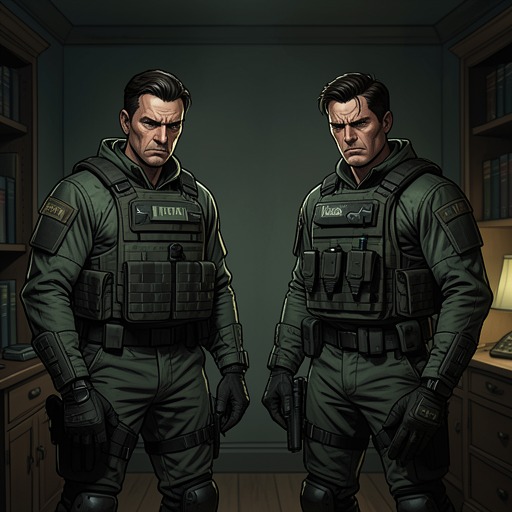
The Invincible’s defenses extend outward into the landscape. Thirty-ton energobots plated with fireproof silicon leave the ramp, spread around the vessel, and bury themselves in the sand until only the shiny positions of their Dirac-transmitter turrets remain visible. Larger inforobots then take positions between them. Their operation produces an invisible dome of protective force over the cruiser, while the power gauge climbs beyond successive gigawatt markings. The ship’s safety is thus not confined to its hull: it is constructed as a ring, a field, and a distributed machine presence across the desert.
This infrastructure gives the crew confidence in procedure, measurement, and controlled exposure. The ship’s force field, robots, rovers, transmitters, maps, and monitoring systems make the alien surface available to scientific inspection. At the selected landing site near the ruins, The Invincible establishes itself almost three and a half miles from the artificial-looking black structures and prepares vehicles, energobots, and a mobile antimatter cannon for work facing the city. The arrangement resembles a scientific station, but the cannon makes clear that observation and coercion are never entirely separate within the expedition.
The cruiser also functions as a communications hub for an exploration network spread across Regis III. When Regnar leads twenty-two men northeast with vehicles, robots, drills, oxygen, food, and nuclear fuel, permanent radio and television contact is maintained until the planet’s curvature blocks the direct line. The Invincible launches a television relay into stationary orbit so reception can continue. Yet this impressive system fails in a manner the crew cannot diagnose: radio reception deteriorates, television reception worsens even though it is relayed from outside the atmosphere, and communication finally breaks off as if a wall of metal had descended across the desert. The failure exposes a limit more fundamental than damaged equipment. The ship can extend its infrastructure across distance, but it cannot guarantee that distance remains communicable.
Expeditionary Base and Scene of Discovery
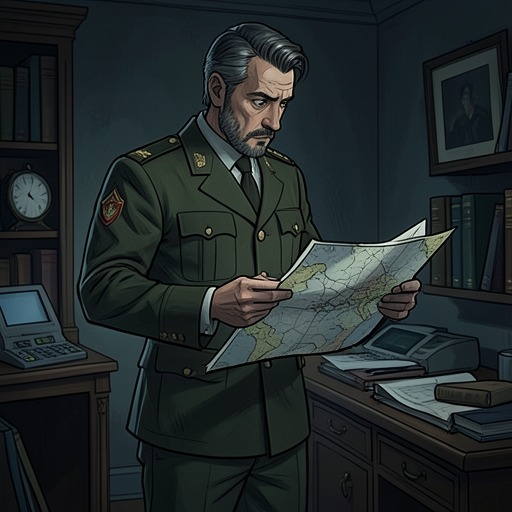
From The Invincible, the crew studies Regis III as a mapped and classified object. A Mercator projection marks continents, seas, polar icecaps, craters, and the landing point at eight degrees north, but the map is explicitly incomplete because it was based on unmanned probes from the previous century. The ship therefore carries knowledge into the planet while also carrying the visible incompleteness of that knowledge. The crew’s hypotheses about ocean life, landward evolution, and the fate of the Condor arise within this framework of partial visibility.
The expedition’s discoveries increasingly make the ship a center of planetary reconstruction. Sedimentary strata contain ruddy-black, non-geological material that may be metallic fragments fused into ancient rock. Deeper drilling reveals organic carbon, fossils of dry-land plants, primitive reptilians, and evidence that land life flourished, disappeared, and later returned in new forms. More recent layers contain increasing quantities of metallic compounds, including antimonite, molybdenum oxide, ferrous oxides, and salts of nickel, cobalt, and titanium. The Invincible’s scientific operation turns the planet into a deep-time archive, but the archive does not yield a simple history. The disappearance of terrestrial life coincides with the emergence of metallic strata, although the measured radiation is insufficient to explain the biological collapse.
The ship’s attempts to connect those clues with the ruins lead to more intrusive work. Scientists demand further research; open-cast excavation proves impractical; and an underground adit is considered despite the danger of working beyond the force field. At a depth of roughly seventy feet, the teams find rusted fragments resembling microscopic mechanisms. The possibility that the ruins, metal layers, and surviving mechanical formations belong to one history makes the planet less like an empty landscape and more like an active system whose past is still materially present.
Crisis, Defeat, and Firepower
The Invincible’s organized expedition gradually becomes a site of mass incapacitation. Within twenty-seven days of landing, almost half the crew has been rendered unable to function. This consequence changes the meaning of the cruiser’s name. The vessel remains operational, but the human force it carries has been reduced by encounters that do not behave like conventional attacks. The ship’s command must respond to effects whose causes are uncertain, and its technical superiority cannot prevent the erosion of the expedition from within.
The recovery of the Condor intensifies that crisis. The missing rocket appears like a crooked tower amid dunes, with tractors almost buried, an immobilized antimatter cannon half immersed in sand, and scattered objects accessible only after the men clear away a thin layer of dust. The discovery is not a triumphal reunion but evidence of another expedition’s disappearance. The Invincible’s personnel can secure the site with transporters, infobots, and a force field, yet the wrecked sister vessel gives the mission a material record of failure that the cruiser cannot erase.
The command’s response is shaped by the need for certainty. Horpach insists that hypotheses are not enough and wants samples of the flying mechanical fauna before withdrawing. He also worries that the formations might eventually threaten space travel in the region. This reasoning treats The Invincible as a vessel responsible not merely for survival but for diagnosis, containment, and possibly preemptive action. Against it stands the recognition that the enemy may not be a thinking adversary at all, but a product of inanimate evolution that has become part of the planet’s natural forces.
The contradiction reaches its most violent point in the attack on the Cyclops. After Rohan has begun to recognize the folly of treating the mechanical formations as a hostile civilization, sirens summon him back to the bridge. A blow passes through The Invincible from stem to stern, and the cruiser returns fire. The skirmish ends with the Cyclops destroyed outside the triple perimeter: its annihilation produces a vast mushroom cloud and measured radiation readings of twenty thousand six hundred at ground zero, nine thousand eight hundred at the perimeter, and fourteen hundred twenty-two inside the field. The ship demonstrates decisive destructive power, but the scene reads less like victory than an experiment in disproportion. The cruiser can obliterate a manifestation of the planetary system while learning nothing that would make the system governable.
Survival, Withdrawal, and Meaning
After the battle, Rohan’s understanding becomes an implicit challenge to The Invincible’s mission. He recognizes that the crew entered the planet rashly, trusted cannons and sensors too much, and suffered because of its own mistakes. The cruiser’s technological confidence has become an ethical liability: it encourages the expedition to interpret whatever resists human comprehension as an enemy requiring conquest. Rohan’s emerging galactocentric understanding instead argues that humanity has no right to attack a form of existence merely because it does not resemble humanity or submit to human values.
The ship remains the practical center of the decision to leave. Its decks hold the exhausted crew, its engines remain ready for immediate takeoff, and its corridors preserve the physical aftermath of sleepless nights and sustained tension. When Rohan hears the ship’s sirens and rushes toward the bridge, he experiences the cruiser almost as a larger body, receiving and parrying forces beyond his individual senses. This fusion of human perception with the vessel’s structure gives The Invincible a final double identity: it is a machine operated by people, but under pressure it also becomes the body through which their collective vulnerability is felt.
At dawn, the rescue operation departs from The Invincible through the force field. Rohan crouches on the rear step of the third jeep, carrying injections, nutritional tablets, a Geiger counter, magnetic sensor, compass, microphotogram map, plastic rope, and a microtransmitter sewn into his collar. The detail of his equipment reduces the legendary cruiser to a point of departure for a solitary human undertaking. Its vast systems remain behind him while survival depends on a small body, limited oxygen, hand-controlled signaling, and instruments that can record danger without explaining it.
The Invincible therefore ends as neither a conquered fortress nor a failed machine. It survives the planet and destroys the Cyclops, but it cannot claim dominion over Regis III, recover a complete explanation for the Condor, or convert uncertainty into moral permission. Its name becomes an irony with ethical force: invulnerability in battle does not amount to knowledge, legitimacy, or victory. The cruiser’s greatest lesson is that a civilization may possess enough power to impose an ending on another form of existence while still lacking the wisdom to decide whether it had the right to begin the confrontation.